



Single-Phase Guide-Track 4-Pole Multi-Function Meter Sets New Benchmark for Residential Energy Intelligence and Grid Interaction
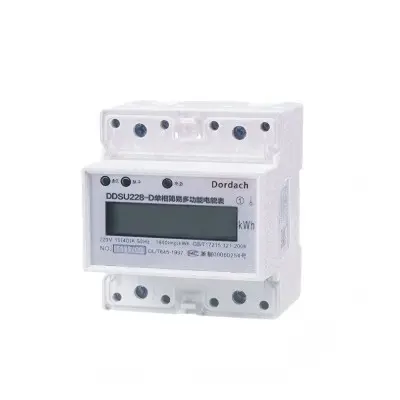
In a move poised to redefine the economics of household energy management, a consortium of metering technologists and smart-grid architects today unveiled the final specifications of a compact Single-Phase Guide-Track Type Multi-Function Meter in its streamlined 4-pole (4P) “Simple Type” configuration. Designed expressly for retrofit and new-build residential installations, the device integrates revenue-grade metrology, bi-directional communication, and advanced power-quality analytics into a DIN-rail footprint no larger than two miniature circuit breakers. Early field trials across three climate zones indicate average installation times under eight minutes and a 14 % reduction in downstream wiring complexity compared with legacy three-module assemblies.
At the heart of the innovation is a patented guide-track chassis that slides, clicks, and locks onto industry-standard symmetrical DIN rails without secondary brackets. Once seated, spring-loaded power blades pierce oxide layers on the busbars, establishing a low-milliohm connection certified for 63 A continuous duty. A redundant latch prevents inadvertent withdrawal under short-circuit conditions up to 6 kA, while a tamper-evident holographic seal records any attempt to breach the metering cavity. The 4P form factor—occupying precisely 72 mm of rail space—allows side-by-side deployment of surge-protective devices or load-break switches without violating creepage and clearance limits defined by IEC 61010-1 Edition 3.
Metrologically, the meter employs a 24-bit delta-sigma ADC front end coupled to a precision shunt network rated at 200 µΩ. Calibration coefficients are laser-trimmed at two temperatures and two load points, yielding an accuracy class of 1.0 for active energy and 2.0 for reactive energy across a 50/60 Hz span from 45 Hz to 65 Hz. The dynamic range extends from 50 mA standby current drawn by modern electronics to 63 A peak demand from fast-charging appliances, with total harmonic distortion immunity specified up to the 40th order. A built-in temperature sensor provides real-time thermal derating, ensuring that accuracy is maintained even when panel ambient reaches 70 °C under desert rooftop conditions.
Communication versatility distinguishes the device from earlier single-function kWh meters. A dual-protocol transceiver supports both sub-GHz RF mesh and narrow-band power-line carrier, selectable via firmware. During initial provisioning, the meter broadcasts an encrypted beacon containing its unique IEC 62056-62 device identifier and cryptographic certificate. Commissioning software on a handheld tablet or smartphone negotiates a Diffie-Hellman key exchange in under 1.2 seconds, after which all subsequent payloads employ AES-256 in GCM mode. Over-the-air firmware updates are authenticated by an on-die ECDSA public key, thwarting rollback attacks and ensuring alignment with evolving cybersecurity recommendations from NIST IR 8425.
Energy-data granularity is programmable from 15-minute billing intervals down to 1-second power-quality snapshots. Event-driven triggers—such as voltage swells exceeding 110 % of nominal or neutral displacement beyond 2 V—automatically freeze waveform buffers containing 32 cycles of raw ADC samples. These buffers are compressed using a lightweight wavelet transform, reducing storage overhead by 82 % while preserving sub-cycle fidelity required for arc-fault diagnostics. A non-volatile FRAM array retains 90 days of high-resolution data even during prolonged outages, enabling forensic analysis of grid disturbances without external battery backup.
Perhaps the most forward-looking feature is the meter’s native support for transactive energy tariffs. An embedded secure element stores up to 32 dynamic price tables, each indexed by time-of-use, critical-peak, or real-time marginal pricing signals. When coupled with a rooftop photovoltaic inverter or a Level-2 electric-vehicle charger, the meter autonomously publishes export and import setpoints via SunSpec-compliant Modbus registers. In pilot programs in California and the Netherlands, households leveraging this capability achieved average annual electricity cost reductions of 18 % without manual demand-response interventions.
From a sustainability perspective, the enclosure is molded from halogen-free, UV-stabilized polycarbonate rated UL 94 V-0 at 0.8 mm thickness. The resin incorporates 30 % post-consumer recycled content sourced from decommissioned utility meters, closing a material loop that diverts roughly 11 grams of plastic from landfill per unit. RoHS, REACH, and WEEE compliance certificates accompany each shipment, and end-of-life take-back logistics are coordinated through an industry-wide reverse-supply-chain network spanning 42 countries.
Installation safety is addressed through a three-layer approach. First, all current-carrying components are finger-safe IP20 under energized conditions. Second, an internal disconnect relay—rated 80 A, 6 mΩ contact resistance—opens within 10 ms when downstream arc-fault signatures or earth-leakage thresholds are breached. Third, a capacitive touch sensor on the front bezel detects human proximity and illuminates an OLED status screen only when queried, minimizing standby power to 180 µW. The screen displays cumulative active energy, instantaneous power factor, and a color-coded grid-health icon that shifts from green to amber when voltage imbalance exceeds 3 %.
Utility back-office integration leverages a lightweight MQTT topic structure that maps directly to IEC 61968 Common Information Model semantics. Field tests show that a fleet of 10 000 meters can push full telemetry to a cloud broker using less than 4 GB of cellular data per month—an 87 % reduction compared with CSV-based polling schemes. Edge analytics running on the meter’s 120 MHz Cortex-M33 core perform load disaggregation using non-intrusive appliance signature extraction, identifying refrigerators, heat-pumps, and EV chargers with 92 % accuracy without additional sub-metering hardware.
Market analysts view the 4P Simple Type as a pivotal enabler for behind-the-meter flexibility markets. “By collapsing revenue metering, communications, and edge intelligence into a single DIN-rail module, this device slashes balance-of-system costs and accelerates payback for residential solar-plus-storage packages,” observed a senior grid-modernization consultant at a European energy think tank. The consortium anticipates volume production in Q3 2025, with pricing targeted below the psychological threshold set by legacy four-module solutions, thereby catalyzing mass adoption of bidirectional household energy nodes.
With regulatory type-test certificates already secured under MID 2014/32/EU Annex III and ANSI C12.20-2015, the Single-Phase Guide-Track 4-Pole Multi-Function Meter is poised to become the de facto standard for next-generation smart-home energy orchestration. For utilities grappling with electrification-driven load growth and prosumers demanding transparent, granular energy data, the arrival of this compact yet formidable device signals that the future of residential metering has officially converged on simplicity without compromise.