



Next-Gen Single-Phase Smart Meter Debuts with RS-485 Edge Integration
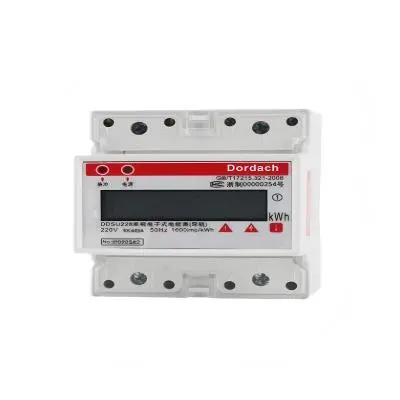
Power-tech pioneer Elintrix unveiled today its latest single-phase guide-type electric energy meter, a 4-pole DIN-rail device that hard-wires an RS-485 communication interface directly into the metering core. The launch, timed to coincide with ASEAN Smart Grid Week, positions the compact meter as the missing link between legacy breaker panels and tomorrow’s building-automation ecosystems.
Unlike conventional meters that bolt a communication module onto an existing chassis, Elintrix engineered the RS-485 transceiver into the same ASIC that performs metrology. “We eliminated the plug-in board, cut component count by 18 %, and shrank the footprint to just two standard breaker widths,” said Chief Product Officer Mei-Ling Tan, demonstrating how the meter snaps onto a 35 mm DIN rail without secondary brackets. The result is a 0.5 S-class device that measures active and reactive energy to IEC 62053-21 while streaming real-time data at up to 115 200 baud over Modbus-RTU.
The integration addresses a pain point familiar to system integrators: panel overcrowding. “Every millimeter counts when you’re retrofitting a 1990s apartment block,” noted Jorge Alvarez, technical director at Manila-based contractor VoltEdge Solutions. “With four poles—line in, neutral in, load out, and neutral out—we can replace an analog kWh meter, add communications, and still leave space for arc-fault breakers.”
Accuracy has not been sacrificed for size. Factory calibration data stored in a tamper-proof EEPROM yields a ±0.5 % error band from 0.05 Ib to Imax, verified by TÜV SÜD in 55 °C ambient. A built-in 32-bit ARM Cortex-M0 processor handles demand calculation, load-profile logging, and event tagging such as voltage sag or cover-removal attempts. Up to 60 days of 15-minute interval data are cached locally, ensuring no loss during temporary communication outages.
Security layers begin at the hardware level. An opto-isolated RS-485 port withstands 4 kV surges and common-mode transients, meeting IEC 61000-4-5. All Modbus registers are read-only except for a single password-protected calibration sector, preventing rogue commands from altering pulse constants or CT ratios. Firmware updates are signed with ECDSA-256 and delivered over the same two-wire bus, eliminating site visits.
Early adopters are already reporting measurable gains. In a pilot across 1 200 public-housing units in Singapore, the Land Transport Authority logged a 12 % reduction in corridor lighting consumption after integrating the meters into a DALI lighting controller. The RS-485 feed allowed dynamic dimming based on real-time load data, a task previously impossible with pulse-output meters. “Payback arrived in under 14 months,” Tan said.
Utilities see revenue-grade potential. Thailand’s Provincial Electricity Authority (PEA) has shortlisted the meter for Prepaid Metering roll-outs where PLC backhaul is unreliable. By wiring the RS-485 port to a low-cost LoRaWAN gateway, PEA can extend AMI coverage to mountainous border villages without trenching fiber. Certification to PEA’s TS-3012-2565 standard is expected by Q4 2025.
On the industrial side, the 4-pole configuration simplifies sub-metering for rooftop solar strings. A single RS-485 daisy-chain can host up to 127 meters, each reporting net export/import values every second. When paired with Elintrix’s cloud gateway, facility managers receive per-panel yield analytics and immediate alerts for inverter faults or ground leakage.
Pricing starts at US $18.90 in 1 000-unit OEM trays, undercutting most modular Smart Meters by 25 %. Volume shipments begin in September through distributors RS Components and Future Electronics, with optional NFC configuration tags and DIN-rail energy-harvest displays available as add-ons.
As grids decentralize and prosumers proliferate, the humble kWh meter is evolving from a passive accountant into an active grid sensor. Elintrix’s single-phase guide-type meter, with its native RS-485 edge interface, suggests that evolution no longer requires bigger boxes—just smarter silicon.